

| Object Title | Jubilee |
| Object Number | 2026-4-13 |
| Current Location | Collections Storage |
| Culture | Yoruba |
| Provenience | Nigeria | Ibadan |
| Culture Area | Yoruba |
| Date Made | circa 1968 |
| Section | African |
| Materials | Cotton | Indigo Dye |
| Technique | Dyed | Hand Painted |
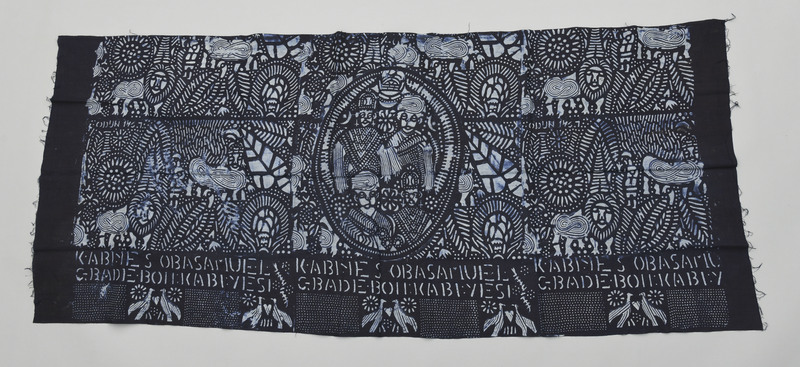
| Iconography | Medallion | King | Queen | Lion | Islamic Knot | Birds | Hearts | Flowers |
| Inscription Language | Yoruba Language |
| Description | Adire Yoruba textile called "Jubilee". Made on a manufactured cotton cloth which is hand-painted with multiple patterned squares using cassava starch. After drying, it is dyed with indigo in above-ground dye pots. The more times the cloth is dipped in indigo, the darker the background and the more vivid the pattern. The pattern is revealed after the cassava starch is beaten off the dried-out cloth. The Jubilee pattern dates to 1935 when it was first made to honor the silver jubilee of King George and Queen Mary, when Nigeria was a British colony.This Jubilee textile is an adaptation of the original Jubilee pattern and was made in honor of the installation of oba (ruler) Samuel Adesina Gbadebo II, the Alake of Abeokuta, Nigeria, from 1963-1971. Patterns on this textile include a medallion with a king and queen inside, a lion whose body is reprsented with an Islamic knot, a woman-headed horse of Mohammed (the horse's body is represented with an Islamic knot and schematic wings), a border with birds, hearts, and flowers. |
| Length | 203.2 cm |
| Width | 85.09 cm |
| Credit Line | Gift of Dr. Sandra T. Barnes, 2026 |
| Other Number | #13 - Collector Number |
Report problems and issues to digitalmedia@pennmuseum.org.