

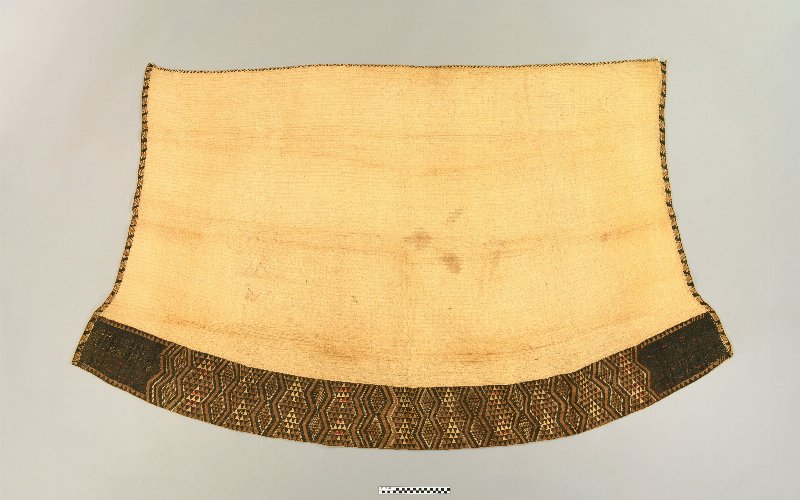
| Native Name | Kaitaka |
| Object Number | 97-120-631 |
| Current Location | Collections Storage |
| Culture | Maori |
| Provenience | New Zealand |
| Period | Te Huringa I Period |
| Date Made | 1800 - 1900 CE |
| Section | Oceanian |
| Materials | New Zealand Flax | Pigment |
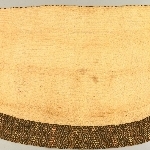
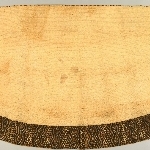
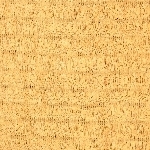
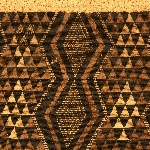
| Description | A kaitaka (cloak) made of muka (processed New Zealand Flax). Broad bottom taniko, 22.8 cm, and narrow side taniko bands, 2.0 cm. The top border is plaited in brown and natural colours. The bottom taniko in brown, black, and natural colours consists of concentric diamonds (waharua kōpito pattern). The weft lines are 1 cm apart with five downward inserts at the shoulders, six downward inserts at the centre, and five downward inserts at the bottom just above the taniko, 88 cm from the top. The kaitaka is a Māori cloak renowned for its fine, silken texture. Made from muka (processed flax fiber) extracted from specially selected varieties of harakeke (New Zealand flax), the kaitaka has a distinctive golden sheen. These cloaks are typically large, designed to wrap around the wearer multiple times. The characteristic feature of a kaitaka is its tāniko borders, bands of intricate, multi-coloured geometric patterns woven along the sides and bottom edges. |
| Length | 203 cm |
| Width | 140 cm |
| Credit Line | Gift of the Academy of Natural Sciences of Philadelphia, 1997 |
| Other Number | L-120-631 - Old Museum Number | 10633 - ANSP Number |
Report problems and issues to digitalmedia@pennmuseum.org.