

| Object Number | P2222 |
| Current Location | Collections Storage |
| Culture | Maori |
| Provenience | New Zealand |
| Period | Te Huringa I Period |
| Date Made | 1800 - 1900 CE |
| Section | Oceanian |
| Materials | Wood |
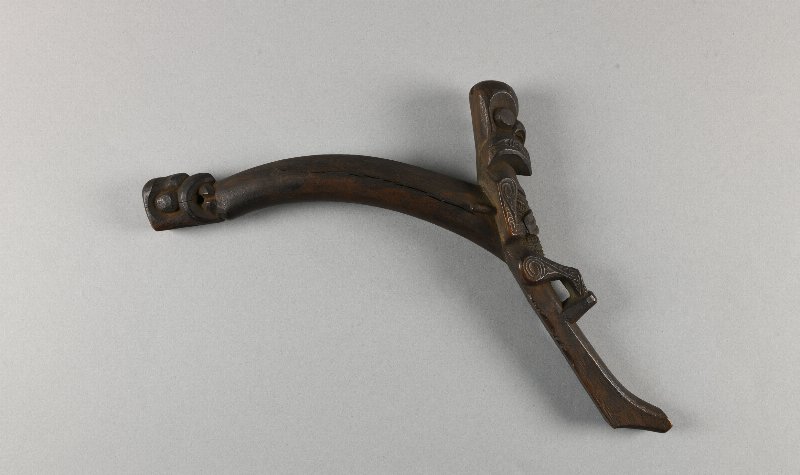
| Description | A mutu kākā (bird snare) made of one piece of wood. The front of the snare has a wheku (carved face that depicts an ancestor) figure with pakura (sequence of spirals, each linked by two parallel ridges that run tangentially from the outer edge of one spiral to the center of the next) carvings along the outside of the arms and legs. Three-fingered folded hands are placed along the stomach of the figure. The opposite end of the snare has a wheku face. Two wooden pins are behind the wheku figure. A mutu kākā snare could be used to capture kākā (parrots) both on the ground and in the trees. The looped cord is draped over the mutu. When a bird landed on the mutu, the cord was tugged and the bird became trapped. The dealer, William Oldman states that this snare was specifically used to trap Tūī (Prosthemadera novaeseelandiae). |
| Length | 38 cm |
| Width | 18 cm |
| Credit Line | Purchased from W. O. Oldman; Subscription of Herbert L. Clark in memory of Edward W. Clark, 1911 |
| Other Number | 17437 - Dealer's Number |
Report problems and issues to digitalmedia@pennmuseum.org.