

Staff
18101
From: New Zealand | North Island | Hawke's Bay Region | Napier
Curatorial Section: Oceanian

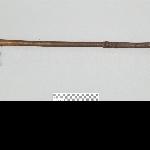
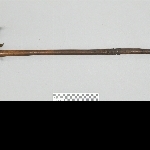
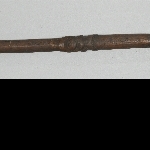
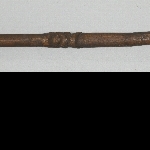
| Native Name | Tewhatewha |
| Object Number | 18101 |
| Current Location | Collections Storage |
| Culture | Maori |
| Provenience | New Zealand | North Island | Hawke's Bay Region | Napier |
| Period | Te Huringa I Period |
| Date Made | 1800 - 1900 CE |
| Section | Oceanian |
| Materials | Wood | Feather | New Zealand Flax |
| Description | A tewhatewha (long handled fighting staff) made of a single piece of wood. The blade (rapa) is curved along one edge. Below the blade is a bundle of feathers (puhipuhi) tied with muka (processed New Zealand flax). One third of the way down the handle is a raised carving, and the end of the handle is pointed (mata). A tewhatewha is a double-handed weapon used in battle for fighting and signaling. When fighting, both the mata and rapa could be used. The rapa was used to hit, while the mata was used to thrust. The puhipuhi would be used to either distract an enemy or signal during battle. Beyond the practical use, tewhatewha were also highly valued in Māori society. They were symbols of authority and would be passed down through the generations. According to notes made by the collector C.D. Voy, the tewhatewha was formerly used by a Māori Chief in Napier, in war and on great occasions. |
| Length | 123.5 cm |
| Credit Line | Gift of William Pepper, 1891 |
Report problems and issues to digitalmedia@pennmuseum.org.