

| Object Number | P2237 |
| Current Location | Collections Storage |
| Culture | Maori |
| Provenience | New Zealand |
| Period | Te Huringa I Period |
| Date Made | 1800 - 1900 CE |
| Section | Oceanian |
| Materials | Wood | Peel |
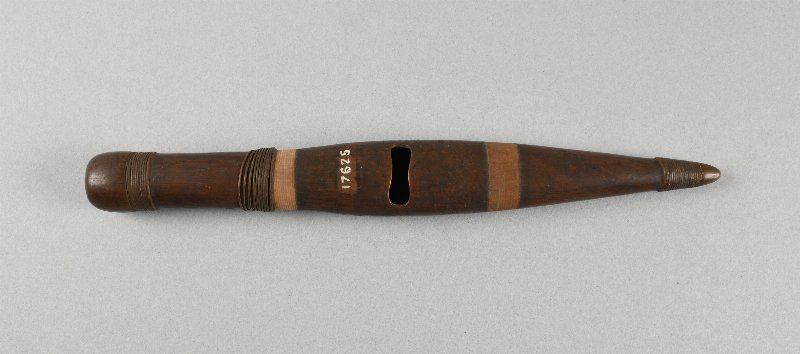
| Description | A pūtōrino (flute) made of two pieces of wood, hollowed out and bound at either end and in two places along the middle with split vines. The flute is polished and undecorated with a hole in the center. The pūtōrino is shaped like a cocoon of the casemoth which is the embodiment of Hine Raukatauri, the goddess of flute music. The woodwind instrument has two (sometimes three) voices. The male voice occurs when the pūtōrino is played through the wider end. The female voice occurs when the instrument is played sideways. Some pūtōrino can sound with a third voice, said to be a spiritual (wairua) voice. It is said that the third voice is Wheke, Raukatauri's daughter. |
| Length | 25 cm |
| Width | 3.2 cm |
| Credit Line | Purchased from W. O. Oldman; Subscription of Herbert L. Clark in memory of Edward W. Clark, 1911 |
| Other Number | 17625 - Dealer's Number |
Report problems and issues to digitalmedia@pennmuseum.org.