

| Object Number | 48-11-1 |
| Current Location | Collections Storage |
| Culture | Maori |
| Provenience | New Zealand |
| Period | Te Huringa I Period |
| Date Made | 1800 - 1900 CE |
| Section | Oceanian |
| Materials | Wood | Abalone | Vine |
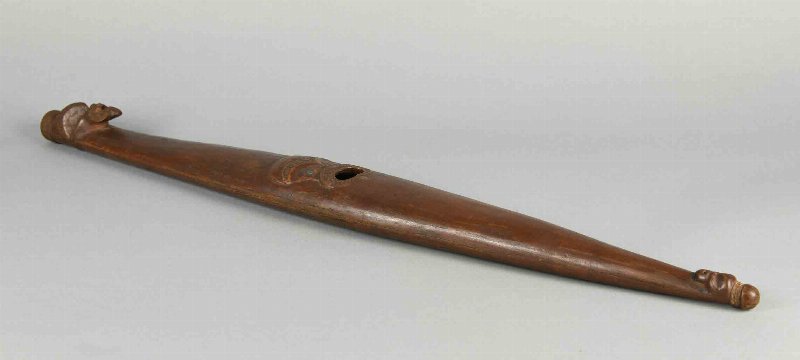
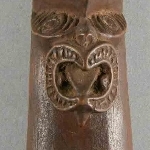
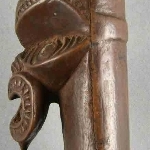
| Description | A pūtōrino (flute) made of two pieces of wood, hollowed out and bound at either end with split vines. Lentoid in section. At the open end, there is a head in high relief with a lower part in the round. There is a small head in high relief at the other end; a face in low relief near the centre, the wide open mouth forming an aperture. Pāua (abalone) shell eyes are in the large head, face, and below the open mouth. The putarino is shaped like a cocoon of the casemoth, which is the embodiment of Hine Raukatauri, the goddess of flute music. The woodwind instrument has two (sometimes three) voices. The male voice occurs when the putarino is played through the wider end. The female voice occurs when the instrument is played sideways. Some putarino can sound with a third voice, said to be a spiritual (wairua) voice. It is said that the third voice is Wheke, Raukatauri's daughter. |
| Length | 69 cm |
| Width | 8.5 cm |
| Credit Line | Exchange with Babette B. Phelps, 1948 |
| Other Number | 128 - Other Number |
Report problems and issues to digitalmedia@pennmuseum.org.