

String Figure
21447
From: United States of America | Hawaiian Islands
Curatorial Section: Oceanian

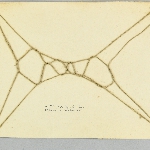
| Native Name | Hei-ma-ka-lu-lu |
| Object Number | 21447 |
| Current Location | Collections Storage |
| Culture | Hawaiian |
| Provenience | United States of America | Hawaiian Islands |
| Culture Area | Oceania | Polynesia |
| Manufacture Location | Philadelphia |
| Date Made | 1898 |
| Section | Oceanian |
| Materials | Plant Fiber |
| Description | A Hawaiian string figure (hei), mounted on a rectangular section of paperboard, identified as pāpio maka liʻiliʻi (pāpio fish with small eyes). This configuration was constructed by a single individual using what was known as the “three-eyed method.” The figure was created at the Museum in 1898 by Hawaiian sailors. The making of Hawaiian string figures (hei) was a well-established recreational practice enjoyed by both children and adults. Using a continuous loop of string, participants manipulated the cord into intricate configurations that showcased dexterity, spatial awareness, and refined manual skill. The practice was supported by a specialized vocabulary: while hei referred broadly to any string figure, terms such as pū and pukaula described specific slipping or release techniques, sometimes performed in competitive or wagering contexts. More than one hundred distinct figures were recorded, many bearing representational or symbolic meanings. |
| Length | 25 cm |
| Width | 18 cm |
| Credit Line | Made in the University Museum by Native Hawaiians, 1898 |
Report problems and issues to digitalmedia@pennmuseum.org.