

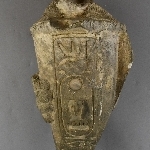
| Object Number | E12469 |
| Current Location | Collections Storage |
| Provenience | Egypt | Abydos |
| Period | New Kingdom | Nineteenth Dynasty |
| Date Made | 1294-1279 BCE. |
| Section | Egyptian |
| Materials | Limestone |
| Iconography | Human |
| Inscription Language | Hieroglyphic |
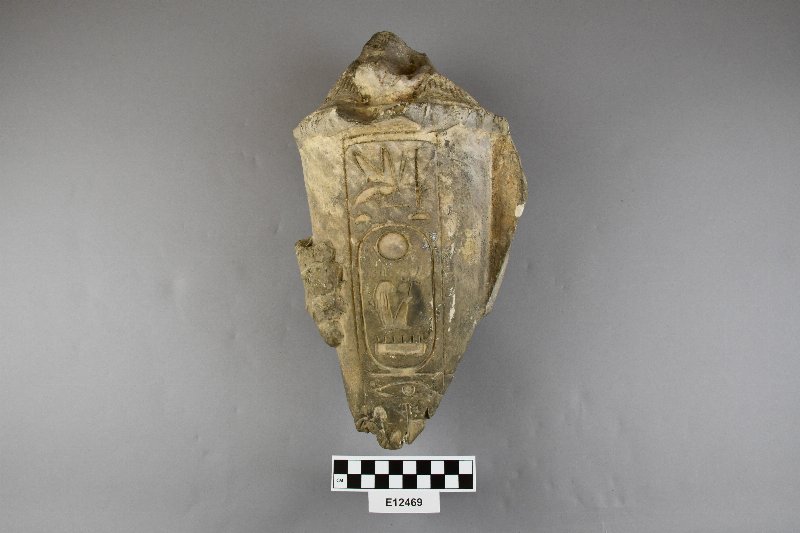
| Description | This limestone fragment originates from a small sphinx statue of Seti I. The statue would have depicted the king in sphinx guise, holding a votive jar that likely contained precious ointment. All that survives are the front of the jar—inscribed with one of the king’s cartouches and an epithet—the fingertips of the sphinx-king’s right hand, and part of the jar’s stopper, preserved in the form of the wig worn by the depicted deity, possibly a ram representing Amun. The cartouche contains the throne name of Seti I, Menmaatre, and is preceded by the title nsw-bity, “King of Upper and Lower Egypt.” The epithet “[beloved] of Osiris” follows the throne name. |
| Height | 36 cm |
| Width | 20 cm |
| Credit Line | Distribution from the Egypt Exploration Fund, 1909 |
Report problems and issues to digitalmedia@pennmuseum.org.