

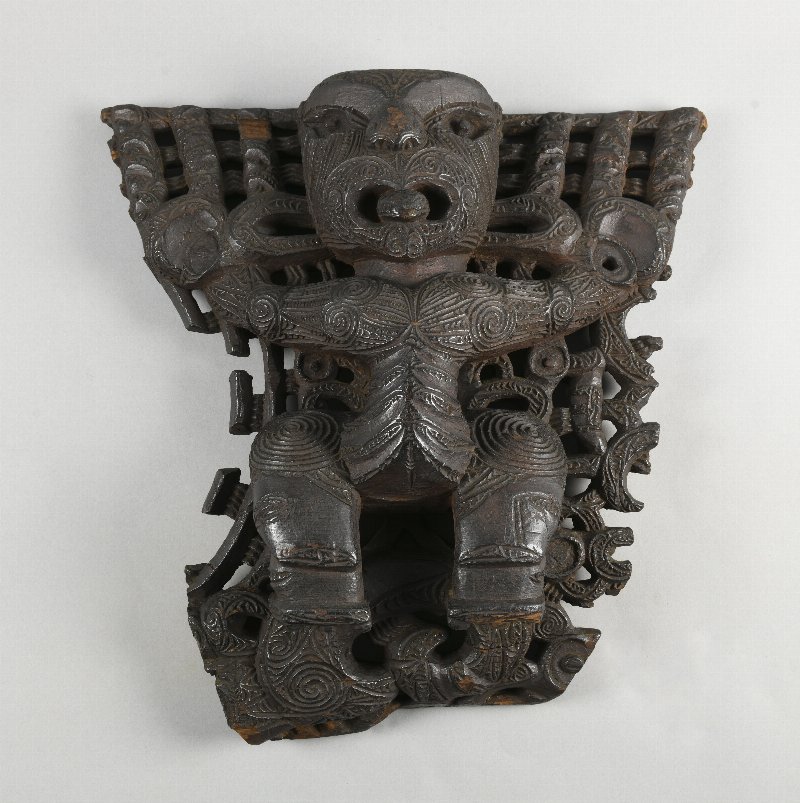
Lintel Fragment
P3222B
From: New Zealand | North Island | Gisborne Region | Poverty Bay
Curatorial Section: Oceanian
| Native Name | Pare | Kōrupe |
| Object Number | P3222B |
| Current Location | Collections Storage |
| Culture | Maori |
| Provenience | New Zealand | North Island | Gisborne Region | Poverty Bay |
| Period | Te Puawaitanga Period |
| Date Made | 1500-1800 CE |
| Section | Oceanian |
| Materials | Wood |
| Technique | Carved |
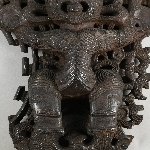
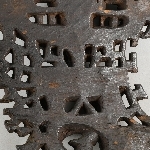
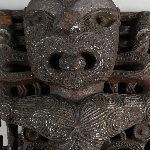
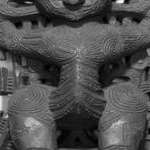
| Description | A wooden pare (door lintel) or kōrupe (window lintel) fragment made of one piece of wood. The female figure, with tongue protruding and arms upraised, is covered with incised designs, including many koru (spirals). There are manaia (spiritual guardian) figures on either side of the face. An openwork lattice with both sides broken off. Te Aitanga-a-Māhaki style. Another, similar fragment from the same pare is in the National Museum of New Zealand /Te Papa Tongarewa in Wellington. Pare and korupe are important architectural elements relating to a wharenui (meeting house). The pare is a carved lintel hung above the doorway, often symbolizing protection and serving as a spiritual threshold between the outside world and the sacred interior of the building. The korupe is a carved lintel hung above a window. It can consist of carvings that are made to represent ancestors or elements of spiritual protection. |
| Height | 42 cm |
| Width | 40 cm |
| Depth | 10 cm |
| Credit Line | Purchased from W. O. Oldman, 1912 |
| Other Number | 24345 - Dealer's Number | 44 - Dealer's Number |
Report problems and issues to digitalmedia@pennmuseum.org.