

| Object Number | 29-96-327 |
| Current Location | Collections Storage |
| Culture | Japanese | Buddhist |
| Provenience | Japan | Buddhist Temple |
| Period | Edo Period (uncertain) | Meiji Period (uncertain) |
| Date Made | 19th Century |
| Section | Asian |
| Materials | Wood | Gilt | Pigment |
| Technique | Carved | Painted | Gilded |
| Iconography | Elephant |
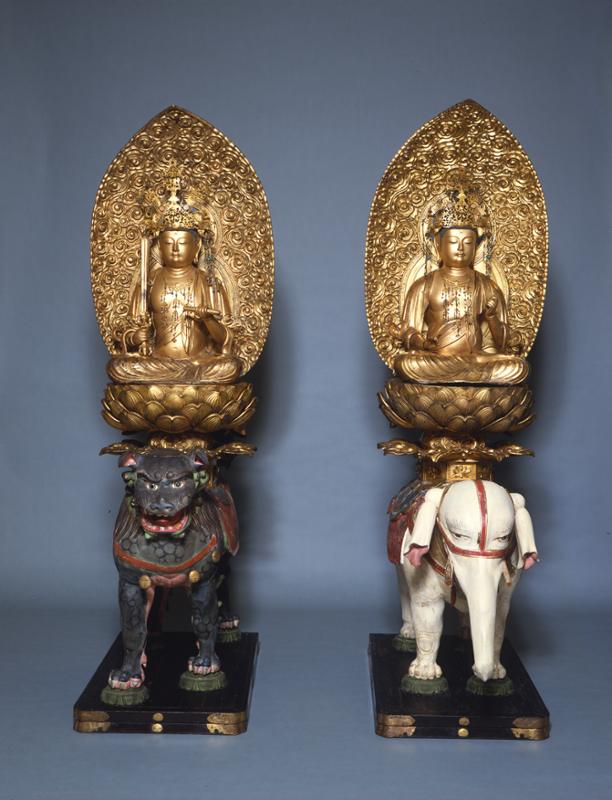
| Description | Carved polychrome wood standing elephant with gold lacquer Fugen seated on top. Elephant is painted white with multi-colored ornaments and saddle. Fugen (Sanskrit: Samantabhadra) embodies goodness. He is described in the Lotus Sutra, a fundamental Mayahana Buddhist text, as a bodhisattva who vows to protect those who devoutly follow the doctrine of the Lotus Sutra. Fugen is frequently paired with Monju. The base for the elephant is 29-96-328D. The Elephant supports a lotus base (29-96-328A and B) for Monju image see 29-96-329. |
| Height | 60.5 cm |
| Width | 107.5 cm |
| Credit Line | Bequest of Maxwell Sommerville, 1904 |
Report problems and issues to digitalmedia@pennmuseum.org.