

| Native Name | Luopan |
| Object Number | 9023 |
| Current Location | Collections Storage |
| Culture | Chinese |
| Provenience | China |
| Period | 19th Century | Qing Dynasty |
| Date Made | ca. 1850 CE |
| Section | Asian |
| Materials | Wood | Lacquer |
| Technique | Lacquered |
| Inscription Language | Chinese Language |
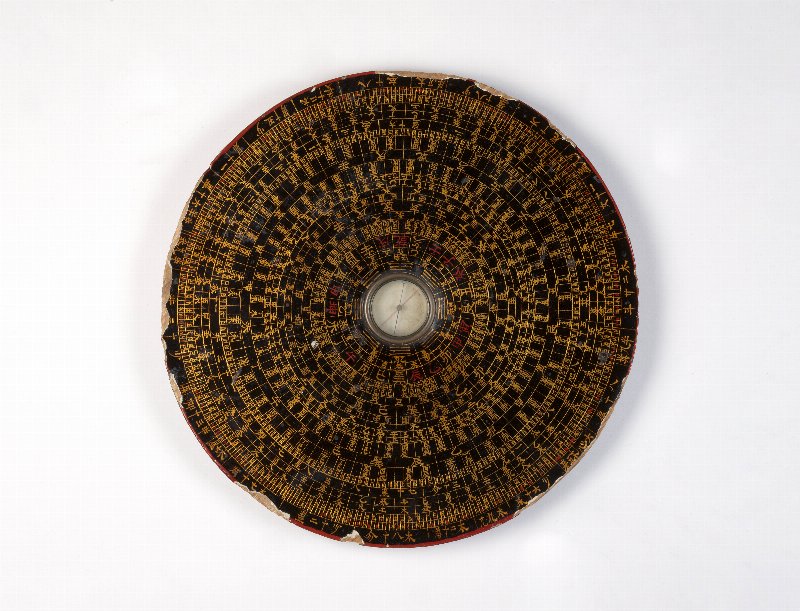
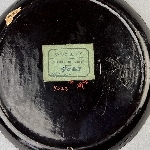
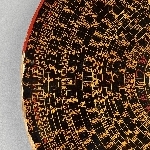
| Description | A "luopan" 羅盤 or fengshui compass. Wood, lacquered, with gold and red lettering on a black ground. A magnetized needle sits in the center, surrounded by concentric rings labelled with the eight trigrams, various combinations of the stems-and-branches (ganzhi 干支), and the 28 constellations of the ecliptic. An inscription painted in red on the bottom identifies the maker: Lin Junzhou Hua ji zao 林君周華記造 "Made by Lin Junzhou of the 'Flowery mark.'" Lin Junzhou appears to have been a mid-19th c. Chinese maker of fengshui compasses, and other examples by this maker are known. The maker's mark is partially covered by an adhesive label that reads "Annam-Tonkin / Collection Th. Chesnay / No. 9023 / China." Théodore Chesnay (d. 1922) was an entrepreneur, newspaper editor, and colonialist in French Indochina. Chesnay founded the newspaper l'Avenir du Tonkin in 1884. A virtually identical compass is in the Whipple Museum of the History of Science, Cambridge (Wh. 0075). |
| Thickness | 1.9 cm |
| Outside Diameter | 20.32 cm |
| Credit Line | Gift of Thomas Hockley, 1891 |
| Other Number | LE352 - Other Number |
Report problems and issues to digitalmedia@pennmuseum.org.