

Bag
18135A
From: New Zealand | North Island | Taranaki
Curatorial Section: Oceanian
| Native Name | Kete Taniko |
| Object Number | 18135A |
| Current Location | Collections Storage |
| Culture | Maori |
| Provenience | New Zealand | North Island | Taranaki |
| Period | Te Huringa I Period |
| Date Made | 1800 - 1900 CE |
| Section | Oceanian |
| Materials | New Zealand Flax | Pigment |
| Technique | Twined |
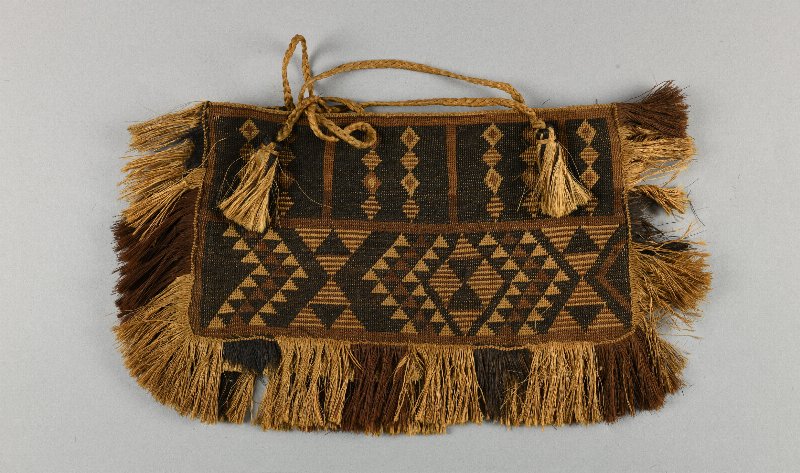
| Description | A kete taniko (bag with geometric pattern) consisting of two twined panels with black, brown, and natural colored diamond and triangle patterns. The upper panel is a waharua kōpito pattern, symbolic of the changes that occur at meeting points. The bottom panel is a Pātikitiki pattern, a flounder pattern, traditionally a symbol of abundance. Fringes around sides and bottom, alternating black, brown, and natural tufts circa 5 cm. long. Braided carrying strap, the ends of which (with tassels of black and natural fiber) are stitched to the four top corners of the bag. A kete taniko is a bag made of weaving dyed muka (flax fiber) into geometric patterns. Taniko is a Māori method of decorative weaving that combines dyeing horizontal threads with the twining technique (whatu). This enabled an increase in design variations. According to notes made by the collector C.D. Voy the bag was made and used by women near Taranaki. |
| Height | 20 cm |
| Width | 37 cm |
| Credit Line | Gift of William Pepper, 1891 |
Report problems and issues to digitalmedia@pennmuseum.org.