

| Object Number | 98-22-11 |
| Current Location | Collections Storage |
| Culture | Miao |
| Provenience | China |
| Period | 20th Century |
| Date Made | 1920 - 1939 |
| Section | Asian |
| Materials | Cotton | Silk (uncertain) |
| Technique | Embroidered | Woven | Appliqued |
| Iconography | Tongzi Hua | 桐子花 |
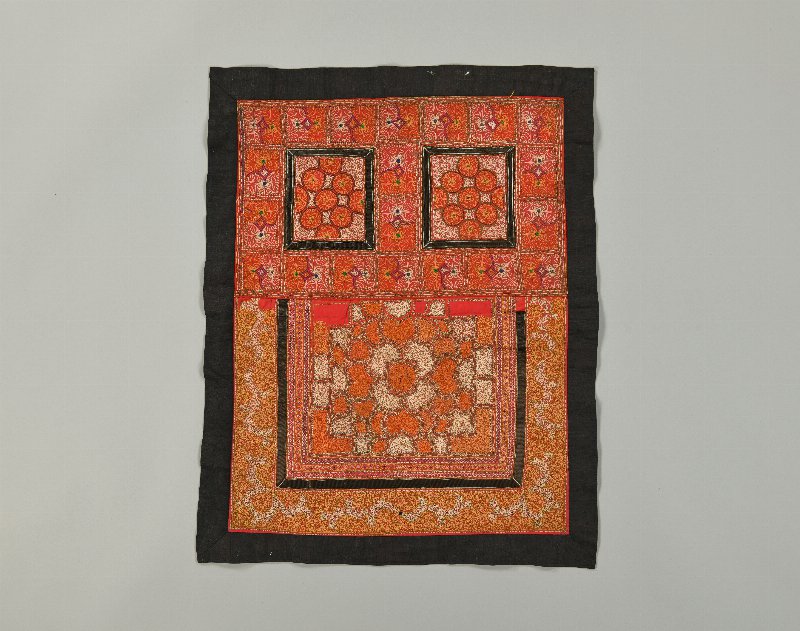
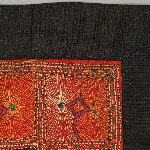
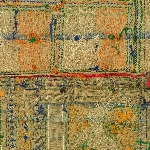
| Description | Embroidered Miao baby carrier from Zhijin (织金), a county in Southwest China. Woven and embroidered by Miao women prior to marriage, baby carriers, also known as beishan (背扇) or beidai (背带), are a way women use to advertise their skills as a wife and mother and express their love for their children. The four corners of the textile are fastened together to hold the baby. In the center, the four-petaled tongzi hua (桐子花), a flower native to the mountains in Guizhou, symbolizes prosperity and fertility. The pattern is filled with chanxiu (缠绣) stitches, a challenging technique that distinguishes the Zhijin-style embroidery from other Miao ones. On top of the flower, there are two identical patches of circular medallions in the same stitch. |
| Length | 94.5 cm |
| Width | 122 cm |
| Credit Line | Gift of Mr. and Mrs. Robert M. Baylis, 1998 |
Report problems and issues to digitalmedia@pennmuseum.org.