

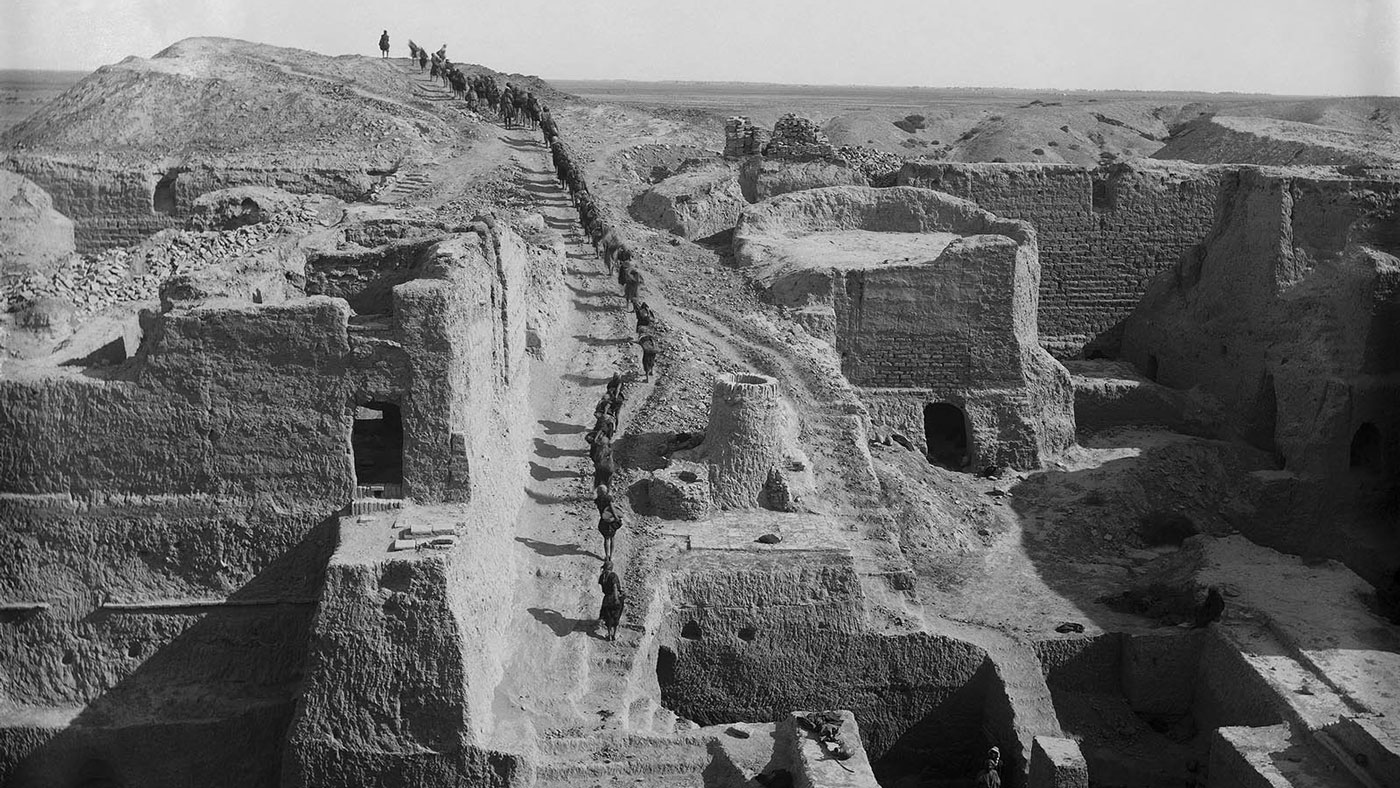
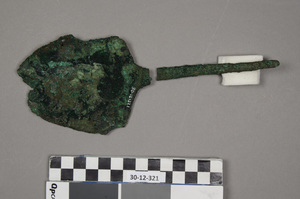
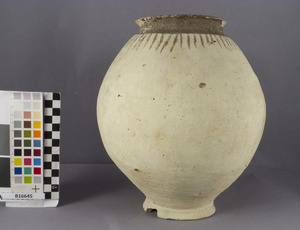
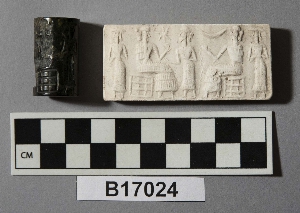
Located in southern Iraq, near the former northern limits of the Persian Gulf, Ur was one of the most famous archaeological excavations—along with Tutankhamun’s tomb in Egypt—during the early 20th century. Frequently described in the popular press, the work at Ur brought the magic of archaeology to life, particularly by tying the discoveries into familiar biblical stories. Between 1922 and 1934, the Joint Expedition of the British Museum and the Penn Museum was directed by C. Leonard Woolley and uncovered some of the most well-known and celebrated art from ancient Mesopotamia. These finds were divided between the two partner institutions (25% each) and the Baghdad Museum in Iraq (50%).
- Object[492]
- no[492]
- babylonian[10]
- near eastern[482]
- adze[3]
- amulet[5]
- animal figurine[2]
- arrowhead[3]
- awl[1]
- axe[5]
- bead[1]
- beads[3]
- belt[2]
- bowl[18]
- bracelet[3]
- brick[16]
- brim[7]
- cape (clothing)[2]
- cast[1]
- chisel[5]
- choker[5]
- cosmetic shell[4]
- cuff[4]
- cup[2]
- cylinder[1]
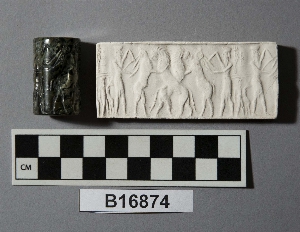
- cylinder seal[37]
- dagger[9]
- dagger sheath[1]
- door socket[4]
- earring[13]
- figurine[10]
- figurine head[1]
- fillet[1]
- finger ring[7]
- flower[6]
- flute[1]
- foundation cone[1]
- foundation figure[1]
- frontlet[2]
- furniture model[3]
- game piece[3]
- garment pin[8]
- goblet[2]
- grinder[5]
- hair comb[6]
- hair ribbon[1]
- hairring[8]
- hammer[1]
- helmet[1]
- holder[1]
- hook[1]
- horse gear[1]
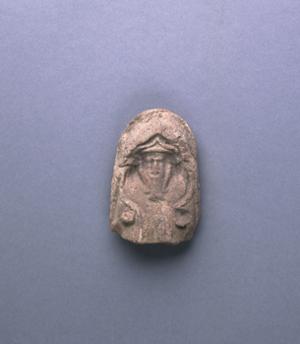
- human figurine[19]
- incense burner[3]
- ingot[1]
- inlay[1]
- jar[14]
- jewelry[10]
- jewelry fragment[3]
- knife[2]
- lance head[1]
- lid[2]
- lyre[1]
- mace[1]
- macehead[4]
- mirror[1]
- model[4]
- nail[1]
- needle[7]
- ornament[1]
- pendant[5]
- pike[1]
- pin[10]
- plow[1]
- pouring vessel[4]
- rattle[1]
- raw material[2]
- razor[1]
- rein ring[1]
- reproduction[7]
- ribbon[6]
- ring[1]
- sealing[7]
- sound box[1]
- spade[1]
- spatula[1]
- spearhead[9]
- spoon[1]
- spouted jar[1]
- stamp seal[3]
- staple[1]
- statue[1]
- statuette[4]
- stela[2]
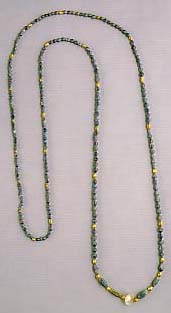
- string of beads[31]
- tablet[5]
- toilet kit[5]
- tumbler[2]
- tweezers[1]
- ur-namu stele[102]
- vase[1]
- weight[4]
- whetstone[2]
- wreath[3]
- achaemenid period[2]
- agade[1]
- akkadian[2]
- archaic[1]
- early dynastic[1]
- early dynastic i[2]
- early dynastic ii[2]
- early dynastic iii[45]
- early dynastic iiib[9]
- early old babylonian period[6]
- isin[1]
- isin-larsa[1]
- kassite[1]
- kassite period[6]
- larsa[9]
- middle babylonian period[8]
- neo-babylonian period[3]
- old akkadian period[2]
- old babylonian period[4]
- persian[2]
- pre-flood[1]
- ur ii[1]
- ur iii[20]
- uruk period[1]
- a.h. upper level[1]
- a.h., against neo-babylonian wall[1]
- a.h., floor level, in # 15 paternoster row[1]
- b.c dungi, room 12[1]
- b.c.[2]
- b.c. against se wall of bur-sin's se annex[1]
- b.c. dungi room 10[1]
- b.c. in filling below floor of intramural chamber of temenos wall[1]
- b.c. in ruins of lrsa houses[1]
- b.c., upper levels, ruins of house 30/c[1]
- bc house, c level[1]
- diqdiqqeh[2]
- isin-larsa[1]
- larsa rubbish pit. pg[1]
- n n c f, house 3, lower level[1]
- n.t. grave 30/18[2]
- p g 1932, house level rubbish[1]
- p.g. 1212[1]
- pft. e 7 - 1000[1]
- pg 1014[1]
- pg 1047[1]
- pg 1054[1]
- pg 1054, domed structure[1]
- pg 1054, head of central person in the domed structure[1]
- pg 1054-c[1]
- pg 1068[1]
- pg 1114[1]
- pg 1116[1]
- pg 1133[6]
- pg 1162[1]
- pg 1170[1]
- pg 1195[2]
- pg 1236, chamber b.[1]
- pg 1237, body 64[1]
- pg 1237/16[7]
- pg 1237/22[4]
- pg 1237/30[1]
- pg 1237/4[5]
- pg 1237/47[1]
- pg 1237/59[1]
- pg 1237/64[11]
- pg 1237/67[4]
- pg 1237/69[3]
- pg 1237/70[5]
- pg 1237/8[3]
- pg 1284[3]
- pg 1366[1]
- pg 1403[1]
- pg 1625[1]
- pg 1687[1]
- pg 1733[1]
- pg 1738[1]
- pg 1739[1]
- pg 800[2]
- sis 7, ad, papsukal box[1]
- sis 7, ad, papuskal box[1]
- altar[1]
- angel[3]
- angel?[1]
- antelope[2]
- antelope?[1]
- arm[2]
- basket[1]
- beard[1]
- bearded god[1]
- bearded man[2]
- bird[1]
- boat[3]
- bottle[1]
- building[1]
- bull[9]
- bull head[1]
- bulls[1]
- butcher[1]
- camel[1]
- chair[2]
- chariot[1]
- chariot wheel[1]
- cheetah[1]
- club[2]
- combat[1]
- crescent[1]
- deer[2]
- deity[1]
- dog[3]
- dog?[1]
- donkey[1]
- dragon[1]
- dress[1]
- drinking tube[1]
- duck?[1]
- eabani[1]
- eagle[3]
- enemy[1]
- enkidu[3]
- female[1]
- figure[1]
- flower[6]
- gazelle[1]
- gilgamesh[9]
- goat[2]
- god[4]
- goddess[3]
- headdress[1]
- hero[3]
- heroes[1]
- human[1]
- hunter[2]
- ibex[1]
- inscription[1]
- king[4]
- lance[1]
- leaf[1]
- libation scene[1]
- lion[14]
- lion head[1]
- lion?[1]
- lyre[1]
- man[1]
- martu[1]
- mask[1]
- monkey[3]
- nannar[1]
- necklace[1]
- net[1]
- nude[1]
- nude man[1]
- nude woman[5]
- owl?[1]
- pazuzu head[1]
- pole[1]
- robe[2]
- seated figure[2]
- seated god[1]
- seated goddess[6]
- seated goddess?[1]
- shell[1]
- skirt[1]
- snake[1]
- standard[1]
- star[2]
- stem[1]
- swan[1]
- swan?[1]
- table[1]
- tree[3]
- ur-nammu[1]
- votary[1]
- warrior[1]
- woman[7]
- worshipper[1]
- wrestler?[1]
- alabaster[20]
- aragonite[1]
- basalt[8]
- bitumen[1]
- bronze[58]
- calcite[3]
- carnelian[34]
- ceramic[8]
- clay[22]
- copper[62]
- copper alloy[14]
- diorite[13]
- egyptian blue[1]
- electrotype[10]
- flint[1]
- frit[6]
- glaze[1]
- gold[93]
- hematite[2]
- ivory[1]
- jadeite[4]
- lapis lazuli[75]
- limestone[12]
- magnesite[1]
- marble (stone)[7]
- paint[4]
- paste[1]
- pigment[4]
- plaster[1]
- porphyry[2]
- quartz[1]
- rock crystal[1]
- sandstone[1]
- shale[1]
- shell[16]
- silver[25]
- soapstone[5]
- steatite[3]
- stone[109]
- terracotta[46]
- travertine[1]
- wood[2]
- yes[492]

1 - 30 of 492 Records

1 - 30 of 492 Records